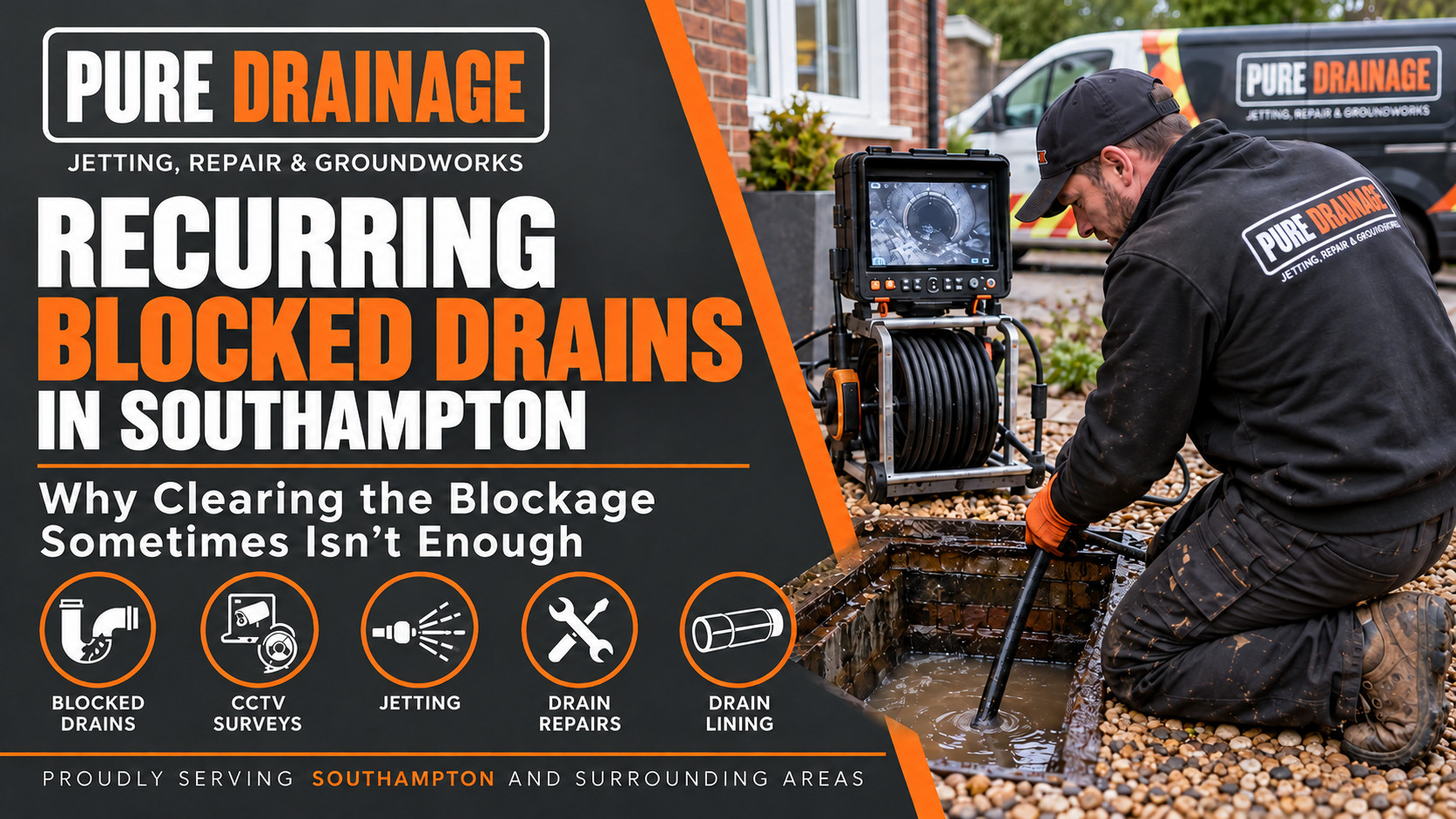
Having a blocked drain cleared should mean the problem is over. However, some homeowners find themselves dealing with the same slow drainage, unpleasant smells or overflowing gullies just weeks or months later.
When a drain repeatedly blocks, it can be a sign that the original obstruction was only part of the problem. Damaged pipework, incorrect pipe gradients, tree roots or stubborn deposits can all cause blockages to return.
At Pure Drainage, we help homeowners, landlords and businesses across Southampton investigate persistent drainage problems through professional drain unblocking services, CCTV inspections, jetting and repairs.
Why Do Drains Keep Blocking?
A blockage occurs when something restricts the movement of water or waste through a drainage pipe. Clearing that obstruction restores flow, but it doesn’t necessarily remove the conditions that allowed it to form.
For example, a cracked pipe joint may repeatedly catch toilet paper, while a build-up of grease can gradually narrow the inside of a kitchen drain.
Unless the underlying issue is addressed, another blockage may develop in the same location.
This can affect properties throughout Southampton, including established residential areas such as Shirley, Bitterne, Portswood, Woolston and Freemantle, where drainage systems may have undergone repairs or alterations over the years.
Common Reasons Drain Blockages Return
1. Grease and Waste Left Inside the Pipe
Sometimes a blockage is cleared sufficiently to let water pass through, but grease, scale and other deposits remain attached to the pipe walls.
Over time, these deposits collect more waste and another blockage forms.
Professional high-pressure drain jetting can remove accumulated deposits more thoroughly, provided the pipework is suitable for the treatment.
2. Tree Roots Entering Underground Drains
Tree roots can enter underground drainage pipes through cracks or defective joints.
Once inside, they may continue growing and trapping waste, gradually restricting the pipe.
Removing the roots can restore flow, but the problem may return if the opening that allowed them into the drain remains unrepaired.
3. Cracked or Displaced Pipe Joints
A damaged drain doesn’t always collapse completely. Even a small displacement between pipe sections can create an edge where waste becomes trapped.
These defects are particularly difficult to identify from above ground. Repeatedly clearing the obstruction may provide temporary relief without correcting the damaged section.
4. Incorrect Pipe Gradients
Drainage pipes need the correct fall to allow wastewater and solids to move effectively.
If pipework has shifted, settled or been incorrectly installed, waste may accumulate in sections where water moves too slowly.
This can be an issue following building work, property extensions or previous drainage alterations.
When Is a CCTV Drain Survey Worth Considering?
If the same drain has blocked several times, a camera inspection can help establish why.
A CCTV drain survey allows engineers to examine underground pipework and identify problems that cannot be seen from the surface.
These may include:
- Cracked or fractured pipes
- Displaced joints
- Tree root intrusion
- Partial pipe collapses
- Heavy deposits or trapped debris
- Sections holding standing water
Rather than relying on repeated clearance, the survey can help determine whether the drain needs cleaning, repair or replacement.
How Are Recurring Drainage Problems Fixed?
The correct solution depends on what the inspection reveals.
Where the pipe is structurally sound but heavily restricted by deposits, thorough jetting may be sufficient.
If damage is found, a localised repair or drain lining may seal the affected section without extensive excavation.
More serious defects, including collapsed or badly displaced pipework, may require professional drainage repairs involving excavation and pipe replacement.
Choosing the right approach after investigating the cause can reduce the likelihood of another blockage.
What If Several Properties Are Affected?
In parts of Southampton with terraced housing, converted properties or shared drainage arrangements, repeated blockages may involve pipework serving more than one building.
If neighbouring properties are experiencing the same problem, it is worth establishing whether the affected pipe is privately owned or part of the public sewer network.
Southern Water is responsible for most public sewers and lateral drains within its service area, while homeowners are generally responsible for private drains serving their own properties within the property boundary.
For further guidance, see Citizens Advice’s information on drain and sewer responsibilities.
How to Reduce the Risk of Another Blockage
Good everyday habits can make a difference, particularly where kitchen and bathroom waste is involved.
Avoid pouring cooking fat into sinks, only flush toilet paper and human waste, and prevent food scraps or unsuitable products from entering the drainage system.
However, if a blockage keeps returning despite careful use, it is worth checking for a structural or installation-related problem rather than assuming the issue is caused by everyday waste.
Recurring Blocked Drains in Southampton? Find the Cause
A drain that keeps blocking needs more than a temporary solution. Identifying why the obstruction repeatedly forms is the key to choosing the appropriate treatment and avoiding unnecessary disruption.
Pure Drainage provides drain clearance, CCTV surveys, jetting, lining and drainage repairs for domestic and commercial customers across Southampton, including Shirley, Bitterne, Woolston, Portswood, Totton, Hythe and Eastleigh.
Contact Pure Drainage today to arrange an inspection and get practical advice on resolving recurring drainage problems.
Do you need help from our experts?
Give us a call today to get expert advice and support from our experienced team.