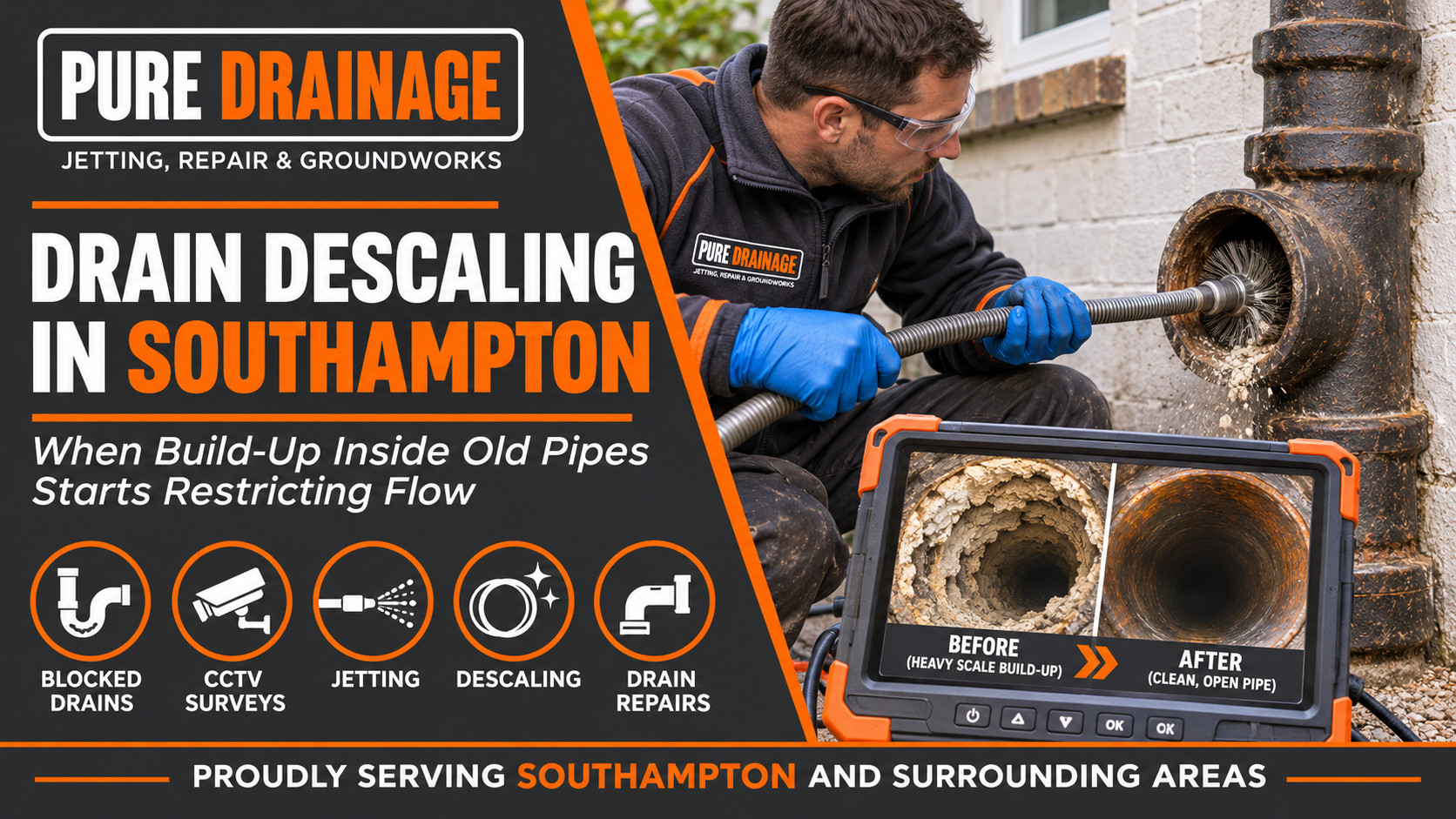
Drainage pipes can gradually become restricted even when there is no obvious blockage. Over time, hard deposits can form along the inside of the pipework, narrowing the space available for wastewater to pass through.
This build-up can cause slow drainage, unpleasant smells and repeated blockages that ordinary drain clearing may not fully resolve.
At Pure Drainage, we provide professional drain jetting, descaling and CCTV inspection services across Southampton, helping homeowners, landlords and businesses identify and remove stubborn deposits from underground drainage systems.
What Is Drain Descaling?
Drain descaling is the process of removing hardened deposits from the inside of drainage pipes.
Unlike a typical blockage caused by wipes, food waste or other debris, scale can become firmly attached to the internal pipe walls. As the deposits accumulate, they reduce the effective diameter of the pipe and make it easier for waste to become trapped.
Depending on the type of deposit and the condition of the pipework, specialist equipment may be needed to break down and remove the material safely.
What Causes Scale to Build Up Inside Drains?
Several types of deposits can develop within drainage systems.
1. Mineral Deposits
Minerals carried in water can contribute to hard deposits within certain drainage environments.
Southampton and the surrounding Hampshire area have varying levels of water hardness, with calcium and magnesium naturally present in water supplies.
However, limescale is primarily associated with heated water systems. A restricted underground drain should not automatically be assumed to have a limescale problem without inspection.
The Drinking Water Inspectorate’s guidance on water hardness explains how mineral deposits form and why hardness varies between areas.
2. Urine Scale in Toilet Waste Pipes
Toilet waste pipes can develop hard deposits associated with urine and wastewater.
These deposits can gradually accumulate within the pipe, particularly where flow is restricted or the pipework has an inadequate gradient.
As the internal opening becomes smaller, toilet paper and other waste may begin catching on the deposits, leading to recurring blockages.
3. Grease and Hardened Residue
Grease and food waste can also form stubborn layers inside drainage pipes.
Although these deposits are different from mineral scale, they can create similar drainage symptoms by reducing the space available for wastewater.
Commercial kitchens and heavily used drainage systems may be particularly vulnerable to this type of build-up.
Signs Your Drains May Need Descaling
Scale accumulation is not always visible from the surface. Homeowners may initially assume they are dealing with a straightforward blockage.
Warning signs can include:
- Water draining more slowly than usual
- Repeated blockages in the same section of pipe
- Gurgling noises from toilets or sinks
- Unpleasant smells from waste pipes
- Reduced flow despite previous drain cleaning
- Hard deposits visible during a CCTV inspection
These symptoms can also indicate damaged pipework, root intrusion or incorrect drainage gradients, so identifying the cause is important before choosing a cleaning method.
Why Older Southampton Properties May Be Affected
Southampton has a mixture of historic terraces, established residential neighbourhoods and newer developments.
Properties in areas such as Shirley, Freemantle, Portswood, Bitterne and Woolston may have drainage systems that have undergone repairs, extensions or alterations over several decades.
Older cast-iron waste pipes, ageing underground drainage and poorly aligned sections can be vulnerable to internal deposits or restrictions.
However, the age of a property alone does not mean descaling is necessary. A professional inspection can establish whether the problem is caused by hardened deposits or another drainage defect.
How Is Drain Descaling Carried Out?
The correct approach depends on the material, diameter and condition of the affected pipe.
1. CCTV Drain Inspection
Before attempting to remove stubborn deposits, a CCTV drain survey can help assess the condition of the pipework.
This allows drainage engineers to identify where deposits have accumulated and check for cracks, displaced joints or other structural weaknesses.
It also helps determine whether descaling can be carried out without risking damage to the existing drainage system.


2. High-Pressure Water Jetting
Professional high-pressure drain jetting can remove certain deposits, grease and accumulated debris from inside pipes.
The pressure and cleaning equipment must be appropriate for the pipe material and condition, particularly when working with older drainage systems.
3. Mechanical Descaling
More stubborn hardened deposits may require specialist mechanical descaling equipment.
Rotating cleaning tools can break down deposits attached to the pipe walls, allowing the loosened material to be removed.
This method requires careful assessment, as aggressive mechanical cleaning can damage fragile or deteriorated pipework.
When Descaling May Not Be the Right Solution
Not every restricted drain can be repaired through cleaning alone.
If a CCTV inspection identifies cracked pipes, displaced joints, significant corrosion or a partially collapsed section, removing deposits may not address the underlying problem.
In these situations, drain repairs or replacement of the affected pipework may be more appropriate.
The aim should always be to restore reliable drainage without causing unnecessary damage to the existing system.
Can Drain Descaling Help Prevent Recurring Blockages?
When hardened deposits are responsible for restricting flow, removing them can help restore the internal opening of the pipe and reduce the likelihood of waste catching in the same location.
However, results depend on the condition of the drainage system and whether other defects are present.
For commercial premises, rental properties and older buildings experiencing repeated drainage problems, inspection and appropriate maintenance can be more effective than repeatedly clearing the same obstruction.
Need Professional Drain Descaling in Southampton?
If your drains remain slow after cleaning, blockages repeatedly return or a survey has identified hardened deposits inside the pipework, professional descaling may be worth considering.
Pure Drainage provides blocked drain clearance, CCTV drain surveys, jetting, descaling and drainage repairs across Southampton and surrounding areas, including Totton, Hythe, Eastleigh, Hedge End and the New Forest.
Contact Pure Drainage today to arrange a drainage inspection and find out whether descaling is the right solution for your property.
Do you need help from our experts?
Give us a call today to get expert advice and support from our experienced team.